Pressure Cooker or Slow Cooker: Which One Earns the Shelf
A practical comparison of pressure cookers and slow cookers, covering speed, texture, and which meals actually benefit from each one.
A pressure cooker turns a chuck roast into fork-tender meat in under an hour. A slow cooker turns the same cut into the same result over eight hours you don't have to watch. Both appliances take up roughly the same square foot of counter or cabinet space, and most kitchens only have room to keep one of them out.
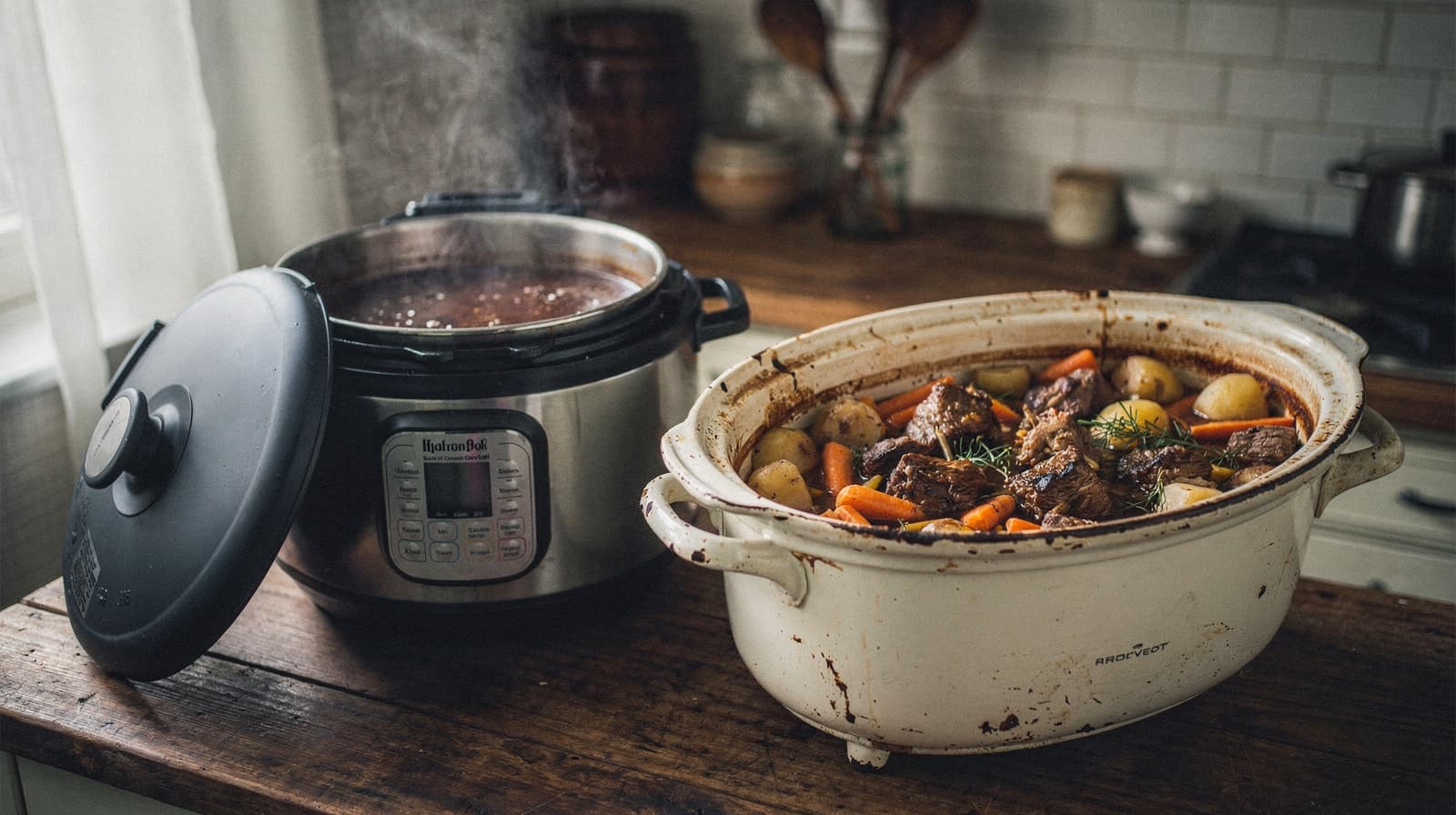
They solve different problems, though, and the choice comes down to which end of your day has ten free minutes in it.
What each one is doing to the meat
Both machines are built to break down collagen in tough cuts, the connective tissue that makes a chuck roast chewy if you cook it fast and hot. Collagen dissolves into gelatin somewhere around 160-180°F, but it takes time at that temperature no matter how you get there.
A slow cooker holds food at a low, steady temperature (roughly 190°F on low, 200°F on high) for hours, using ambient heat and a sealed lid to keep moisture in. A pressure cooker raises the boiling point of water by sealing the pot and building internal pressure, which pushes the cooking temperature up to around 250°F. That's the entire trick: higher temperature means the same collagen breakdown happens in a fraction of the time.
Texture is where they part ways. Pressure-cooked meat tastes a shade less developed than the long version, because the flavor compounds that build over eight hours of gentle simmering don't have as long to form. Most people can't tell the difference in a stew. In a barbacoa or a French dip, a patient cook might.
Where the pressure cooker wins
Speed is the whole pitch. A pot of dried pinto beans goes from raw to soft in 25-35 minutes under pressure, no overnight soak required. A whole chicken cooks in about 25 minutes. Risotto, which normally demands 20 minutes of stirring, needs about 6 minutes plus a quick pressure release.
It also wins on weeknight timing. You can decide at 5:30 that you're making chili and eat by 6:30. A slow cooker needs a decision made that morning, or the night before if you're using the "low" setting.
Frozen ingredients are the other gap. Toss in frozen chicken thighs straight from the freezer and add 5-10 minutes to the cook time. A slow cooker handles frozen meat badly, and food safety guidance says don't: the food sits in the bacterial danger zone (40-140°F) too long before the appliance gets it hot enough.
Where the slow cooker wins
It requires none of your attention once it's loaded. Pressure cookers need someone home to start them, monitor the come-up-to-pressure phase, and manage the release. A slow cooker goes on the counter at 7 AM and needs nothing until dinner. For a household where mornings are the only slack in the day, that's worth more than saved cook time.
It's also more forgiving of exact timing. A slow cooker recipe that says "6-8 hours" really does work fine at 6 or at 8; there's a wide margin. A pressure cooker recipe that says 35 minutes usually means 35 minutes, and overshooting by 10 can turn short ribs to mush or leave rice gluey.
Big cuts benefit from the slow cooker's patience, too. A whole pork shoulder for pulled pork can go in a slow cooker for 8-10 hours and shred with two forks; a pressure cooker gets there in 90 minutes, but you'll pull out a few chunks that fight the fork because the meat hasn't had as long to relax.
The combo-device tradeoff
Multi-cookers that do both (pressure, slow, sauté, rice) solve the shelf-space problem, at a cost. Combo units run $80-150 versus $25-40 for a basic slow cooker or $60-100 for a dedicated pressure cooker, and the slow-cook function on most combo units is weaker than a standalone slow cooker's, because the heating element is designed around pressure cooking first. Use both modes most weeks and the combo is worth it. Use one mode 90% of the time and you should buy the dedicated version of that one and skip the combo tax.
Noise, safety, and the learning curve
A pressure cooker has a real learning curve that a slow cooker doesn't. You need to understand quick release versus natural release, why you shouldn't force the valve open on something starchy like oatmeal or beans (the foam can spray out with the steam), and why the lid won't open at all until pressure has fully dropped. None of this is dangerous once you know it, but the first few uses involve a manual and a bit of caution that a slow cooker never asks for.
Modern electric models like the Instant Pot have redundant safety valves and won't pressurize with the lid improperly sealed, which has made the appliance far safer than the stovetop jiggle-top cookers a previous generation grew up fearing.
Noise is a smaller but real difference. Electric pressure cookers hiss audibly during release, sometimes for several minutes on a natural release, which can startle a napping toddler or a dog that's never heard it before. A slow cooker is close to silent the entire time it runs, which matters if it's going to sit on a kitchen counter near a nursery or a home office all day.
Cleanup favors the slow cooker too. Most slow cooker inserts are ceramic and dishwasher safe, and there's no pressure valve or sealing ring to clean separately. Pressure cooker sealing rings need regular washing and occasional replacement (they run $8-12 and should be swapped roughly every 12-18 months of regular use), since a worn ring is the most common reason a pressure cooker won't seal properly.
Which one to buy first
If your week has a predictable slow morning (you're home, or someone is) and a chaotic evening, buy the slow cooker. Load it before the day gets away from you and dinner is handled.
If your days are unpredictable and dinner decisions happen at 5:45, the pressure cooker fits better. It is the only one of the two that rewards a last-minute decision.
Either one earns its shelf space if you're cooking the kind of meals that need low-and-slow collagen breakdown: braises, stews, dried beans, bone-in proteins. If your weeknights lean toward one-pan dinners that finish in 20 minutes on the stovetop, neither appliance adds much, and the money is better spent on a good Dutch oven.
Building a rotation around whichever you buy
Once you've picked one, the highest-value move is batch cooking proteins in it on a day you have time, then portioning the results for the week. A slow cooker full of shredded chicken on Sunday turns into tacos Monday, a grain bowl Wednesday, and soup Friday. A pressure cooker full of beans on a weeknight covers three lunches without you touching the stove again.
If you're tracking recipes by which appliance they need, tagging them in RecipeClip as "pressure cooker" or "slow cooker" makes it easy to filter to what you can cook on a given night, and pairs well with a freezer stash for the weeks neither one gets touched.
Before you buy either, look at next week's calendar and count the mornings with ten free minutes in them. That number picks the appliance.