The Kitchen Tools Worth Buying and the Ones Gathering Dust
Which kitchen tools earn their space and which end up in the back of a drawer. A practical guide before your next kitchen purchase.
Somewhere in your kitchen is a garlic press, a melon baller, or an avocado tool that's been used twice. Meanwhile your one decent chef's knife comes out fifteen times a day and hasn't been sharpened since you bought it. Kitchen tool spending almost never tracks how much a tool gets used. Worth sorting out before the next purchase.
What earns its space
Five tools do most of the real work in a home kitchen. Spend money on these.
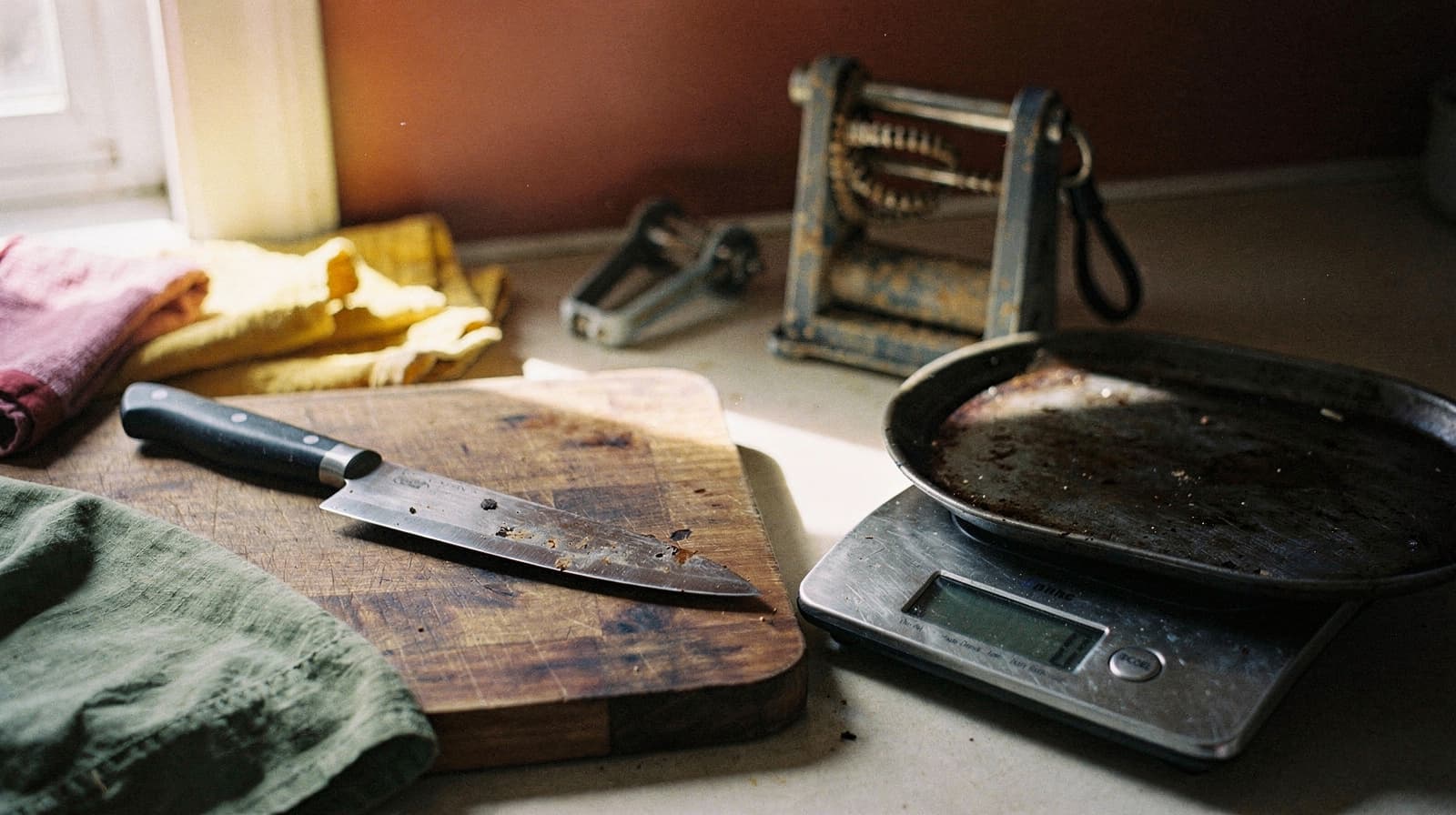
A chef's knife you like holding matters more than anything else here. An 8-inch blade handles 90% of cutting tasks, and the gap between a $15 knife and a $60 one isn't the steel, it's balance and edge retention. Buy one that sits well in your hand, run it through a $15 pull-through sharpener every few months, and it will outlast a decade of gadget purchases.
Buy a large cutting board. Undersized boards cause more daily frustration than any other tool problem: chopped onion tumbles off the edge, and there's nowhere to push the scraps while you keep cutting. Go at least 15x20 inches, about $20-30 in plastic or $40-60 in wood.
One heavy-bottomed pot covers soup, braising, pasta water, and anything that starts on the stove and finishes in the oven. A 5-6 quart Dutch oven is the most versatile piece of cookware most kitchens own, and a decent enamel-coated one runs $60-90 if you skip the premium brands.
An instant-read thermometer costs fifteen dollars and ends the guessing on chicken, steak, and bread. Nothing else in the kitchen returns as much per dollar.
Good kitchen shears, $15-25, spatchcock a chicken, trim herbs, break down a rotisserie bird, and open the packaging that defeats your fingers.
What sounds useful but usually isn't
A handful of single-purpose tools get bought with good intentions and then sit unused, because a knife or a pan already handles the job.
- Garlic press. A chef's knife and the flat of the blade mince garlic just as fast, with nothing extra to wash
- Avocado slicer. A knife and a spoon, same ten seconds
- Egg separator. Crack the egg into your hand and let the white run through your fingers
- Melon baller. One job, and melon is fine cubed
- Banana slicer. This exists. A knife takes three seconds
None of these are bad products. They solve problems that don't need a dedicated tool, and they end up in a drawer that gets harder to open every year.
The middle category
Some tools are excellent, but only if your cooking calls for the task often. A stand mixer is worth $200-400 if you bake bread or cookies weekly, and dead weight on a shelf if you bake twice a year. A rice cooker earns its $30-60 in a house that eats rice on Tuesdays, and sits idle in one that already knows the pot-and-lid method.
Count how many times in the last month you did the task by hand. Zero or one, and the tool is solving a problem you don't have often enough to give up the counter space.
Maintenance matters more than the initial purchase
A $60 knife gone dull cuts worse than a $15 knife kept sharp. The tools above only pay off if you maintain them, and maintenance costs less time than people assume. Run a honing steel down the blade before each use, five seconds, and the edge stays aligned between real sharpenings every few months.
Boards need attention too. Wood wants a food-safe mineral oil rub every few weeks or it dries and cracks. Plastic gets replaced once deep knife grooves build up, because washing doesn't reach the bacteria down in them. Skip both jobs and within a year or two your decent equipment performs like cheap equipment.
Organizing what you keep
A drawer full of rarely-used gadgets makes the daily tools harder to find. If you're rethinking what stays and what goes, our guide to organizing a small kitchen covers storage that works when counter and drawer space is tight, including where to put the single-purpose tools you keep anyway.
Once the tools are sorted, build the habit of having everything measured and within reach before the pan gets hot. Our piece on mise en place covers that setup, and it will do more for your cooking than any gadget on this list.
The one-in-one-out rule
Tempted by a new gadget? Two tests. It has to replace something you'd otherwise do with a knife, a pan, or your hands, and it has to save minutes, not just feel good the first time you use it. A garlic press feels good. It saves you about eight seconds over the flat of a blade.
Before the next kitchen purchase, open the gadget drawer and count what's been used in the last month.