How Accurate Are Online Recipe Converters?
We scaled 285 ingredient lines from 25 real recipes with two free converters. The misses were glued units, ranges, eggs and odd fractions.
A recipe converter has three jobs. It multiplies every amount, it turns each answer into something you can measure, and when you switch units it weighs each ingredient by what that ingredient is. The mistakes cluster in a few kinds of line: an amount written against its unit ("200g"), a range ("1½-2 tbsp"), a count you can't split (eggs, garlic cloves), and an answer like "1 1/8 cups" that leaves you to do the last conversion by hand.
We measured how often that happens. In October 2026 we ran 285 ingredient lines from 25 real recipes through two free converters: the recipe converter at mykitchencalculator.com and our own.
How we tested
We took the ingredient lists from 20 recipe pages: 7 from BBC Good Food, 5 from King Arthur Baking, 3 from Spend With Pennies, 2 each from Once Upon a Chef and Natasha's Kitchen, and 1 from Pinch of Yum. King Arthur prints a gram weight beside each cup measure, which would give the answer away, so we deleted those weights and left everything else as published. That came to 228 lines. Each recipe got a servings change (10 to 15, 15 to 10, 6 to 10 and so on) and a target: US to metric, metric to US, or keep the units.
The answer key takes grams per cup from King Arthur Baking's ingredient weight chart, with USDA figures for the few ingredients it does not list. A line counted as right when it met these rules:
- A metric answer is within 5% of the true amount.
- A US answer is within 7%, or is the nearest step you can measure (quarter cups, eighth teaspoons). "1 1/8 cups" failed even when the arithmetic was right, and "1 cup + 2 tbsp" passed.
- A range stays a range, with both ends scaled.
- "To taste", "a pinch" and "to decorate" stay as words, with no invented quantity.
mykitchencalculator.com scales lines but does not convert units, so we also scored the 140 lines that only need scaling: counts, cans, spoon measures, and the two recipes that only change servings. We ran it on its default settings, after checking that turning its rounding off made its score worse.
We built our converter against those 20 recipes, so a perfect score on them says more about our debugging than about the tool. On October 16 we froze 5 more recipes that it had not been built against: 57 lines from Well Plated, Taste of Home, olive magazine and BBC Food. Its first run on them scored 53 of 57, with 34 of the 35 scaling lines right. We then fixed the one scaling miss (cilantro by the cup), so today's run on those recipes is a little generous. Weigh the held-back numbers most, and keep that in mind.
The results
| Lines correct | RecipeClip | mykitchencalculator.com |
|---|---|---|
| 20 recipes, all 228 lines | 228 | 120 |
| 20 recipes, 140 scaling-only lines | 140 | 120 |
| 5 held-back recipes, all 57 lines | 54 | 29 |
| 5 held-back recipes, 35 scaling-only lines | 35 | 29 |
We ran the current build of our converter on October 31, 2026. mykitchencalculator.com was run on October 15 (the 20 recipes) and October 16 (the 5 held back), so it may behave differently now.
Most of the gap in the "all lines" rows is unit conversion, which mykitchencalculator.com does not attempt. The scaling-only rows compare like with like. There it got 120 of 140 and 29 of 35 right, and ours got every line. Our three misses on the held-back recipes were all the same kind of line, covered under "Where ours is still wrong."
Five kinds of line that trip converters
Amounts written against their unit
Scaled by 1.5, "200g caster sugar" should become 300 g. mykitchencalculator.com printed "200g caster sugar", unchanged. In a recipe halved from 10 servings to 5, "225g caster sugar" also stayed at 225g. It did not scale a number with no space before its unit, and recipes from the UK rarely leave one.
Ranges
Scaled by 1.5, "3/4 to 7/8 cup granulated sugar" came back from mykitchencalculator.com as "1 1/8 to 7/8 cup". The first number was scaled and the second was left alone, so the range now runs backwards. At two-thirds, "1½-2 tbsp orange juice" became "2/3 1/2-2 tbsp". Its help page describes a "##" marker you can type before a second number to scale that one too, so a careful user can fix this by hand. Pasted as written, the range breaks. Ours printed "1 to 1 1/3 tbsp orange juice".
Things you count
Brownies scaled from 12 to 16 servings turned "4 eggs" into "5 1/3 eggs". A curry going from 4 to 5 servings turned "3 garlic cloves" into "3 3/4 garlic cloves". Ours rounds whole items to something you can pick up (5 eggs, 4 garlic cloves). When the math lands exactly on a half, as with one egg halved, it keeps the half egg and adds a note: "Whisk an egg and use half of it."
Answers you can't measure
mykitchencalculator.com rounds to the nearest eighth by default. In a banana bread scaled from 10 servings to 15, "3/4 cup granulated sugar" became "1 1/8 cup". The arithmetic is right, but measuring-cup sets usually stop at a quarter cup, so you still have to work out that the extra eighth is 2 tablespoons. Ours prints "1 cup + 2 tbsp granulated sugar".
Cups that need a weight
Turning cups into grams takes a weight for each ingredient. By King Arthur Baking's chart, a cup of all-purpose flour weighs 120 g, granulated sugar 198 g and packed brown sugar 213 g. A converter also needs to say so when it has no weight. Ours has weights for 54 ingredients. Anything else keeps its cup measure with the note "No reliable weight for this one, so it stays as a measure."
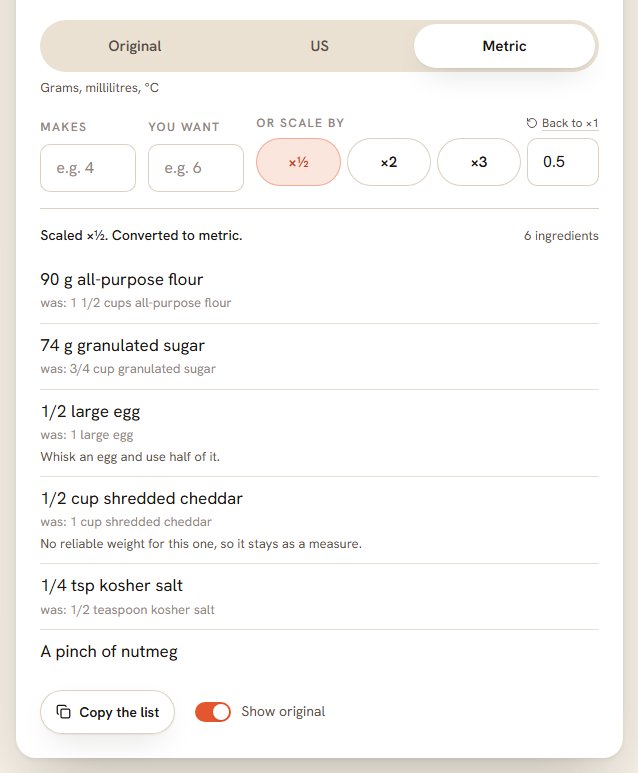
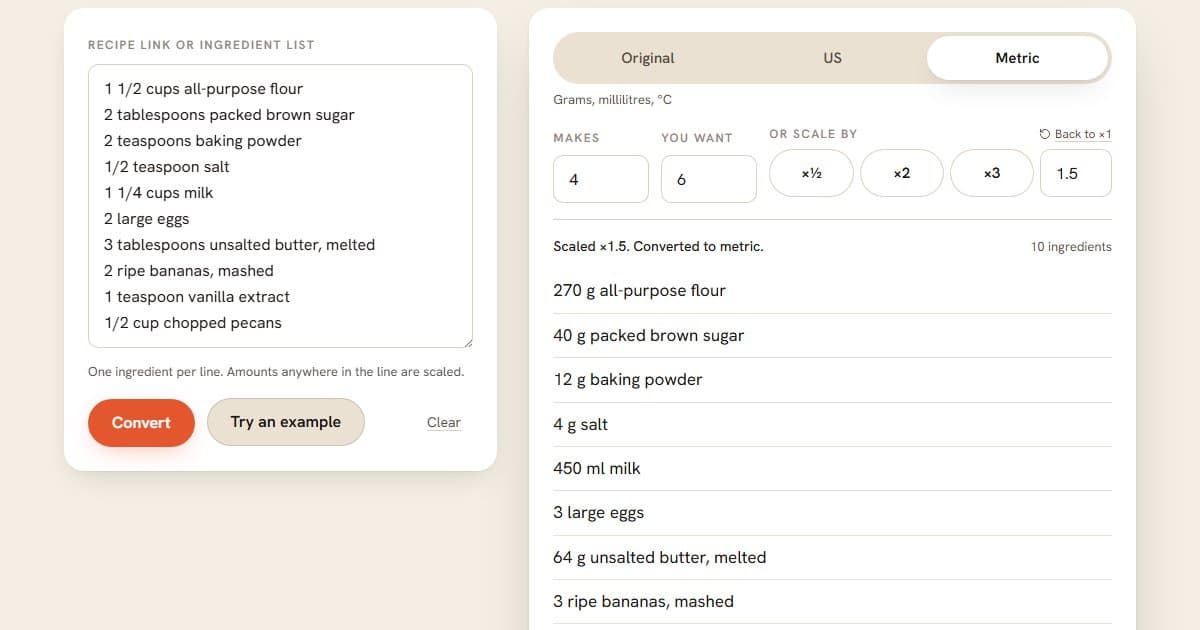
Above, six lines we pasted into our converter, halved and set to metric with "Show original" on. Flour and sugar get grams, the egg gets its note, and the pinch stays a pinch. Shredded cheddar keeps its cup because we have no weight for it, and kosher salt keeps its spoon on purpose, because a teaspoon of it weighs different amounts from brand to brand.
Oven temperatures stay put
Doubling a cake does not call for a hotter oven, but a converter that multiplies every number on the page will give you one. An early build of ours did that in testing, turning 350°F into 370°C on a doubled recipe. Now temperatures only change units. "350-375°F oven" reads "175-190°C oven" at any scale, using the round numbers printed on oven dials rather than the exact 177°C. "Gas mark 4" becomes "350°F (gas mark 4)", and a 9-inch pan becomes a 23 cm pan.
Cooking times are a separate question. A doubled batter in a deeper pan takes longer, but not twice as long, so start checking at the original time. Our guide to scaling a recipe covers pans, times and the seasonings worth tasting as you go.
Where ours is still wrong
- All three misses on the held-back recipes were ingredients we have no weight for. In a US-to-metric conversion, 2 cups of diced apples and 3 cups of cubed potatoes stayed in cups, and half a cup of caramel sauce became 6 tbsp. The answer key wanted grams, or millilitres for the sauce.
- Amounts in brackets are not scaled. Scaled by 1.5, a line for 3 very ripe bananas, "about 1 1/2 cups mashed", became 4 1/2 bananas with the "1 1/2 cups mashed" left as written.
- A note can send the weight lookup to the wrong ingredient. "1 teaspoon salt, (plus more for the pasta water)" came out as "8 ml salt", measured like water.
- Amounts written inside the method are not scaled, and the result says so under the steps. "Add half the butter" still works, but "stir in 2 tablespoons of the sauce" stays at 2.
Check a converted recipe in a minute
- Count the eggs and other whole items. A fraction of an egg should come with instructions, and a fraction of a garlic clove should not appear at all.
- Read every range. Both ends should move.
- Spot-check one weight. A cup of all-purpose flour near 120 g and a cup of sugar near 200 g means the converter is weighing by ingredient.
- Find the oven temperature. It should be the same heat in the new units, never a new heat.
- Read the method for amounts and times that the list does not carry.
Try the converter
Paste a recipe link or an ingredient list into the free recipe converter. Set "Makes" and "You want", or tap ×½, ×2 or ×3, then pick Original, US or Metric. "Show original" puts the old amount under each line so you can check our work, and "Copy the list" copies the result. Pasted lists are converted in your browser. A link is read from the recipe data the page publishes, and only a page without that data is read by AI, which uses one of 8 free AI reads a day. It is free and needs no account. To keep a converted recipe, save it to a free RecipeClip account, which holds up to 50 recipes.
The help article walks through each setting, and converting recipes to metric has the conversion charts if you would rather work by hand.
Disclosure: RecipeClip publishes this blog and makes one of the two converters we tested.
Frequently Asked Questions
How many grams is a cup of flour? About 120 g of all-purpose flour, by King Arthur Baking's chart. Whole wheat flour and almond flour weigh less per cup, so a good converter reads the whole ingredient name, not only the word "flour."
Should the oven temperature change when I double a recipe? No. Keep the temperature and watch the time. A bigger or deeper batch usually needs longer in the oven, and sometimes a second pan.
Can I scale eggs? Round to whole eggs where you can. When the math forces half an egg, whisk one egg and use half of it, about 25 g.
Why does the converter keep some lines in cups? Because it has no reliable weight for that ingredient. Leaving the cup measure is safer than guessing a weight, and the line says so.