Saving Handwritten Family Recipe Cards Before the Ink Goes
Handwritten recipe cards fade, get separated in a move, or live with one sibling who never shares them. Here's how to save and split a family archive properly.
A recipe box has one copy of your grandmother's rugelach card, and it lives at your aunt's house. If that box goes through a flood, a move, or just forty more years of pencil fading against a grease-stained index card, that recipe is gone in a way no amount of remembering the general idea will fix. Archiving family recipes isn't the same job as digitizing a cookbook. There's one copy, the handwriting is shorthand that one or two living people can still read, and the point isn't storage. The point is getting it into several houses and, eventually, several generations.
We've covered the mechanics of scanning recipes with AI in how to digitize your cookbook collection. This is what changes when the source is a fading card instead of a printed book you could buy again.
Photograph before you transcribe
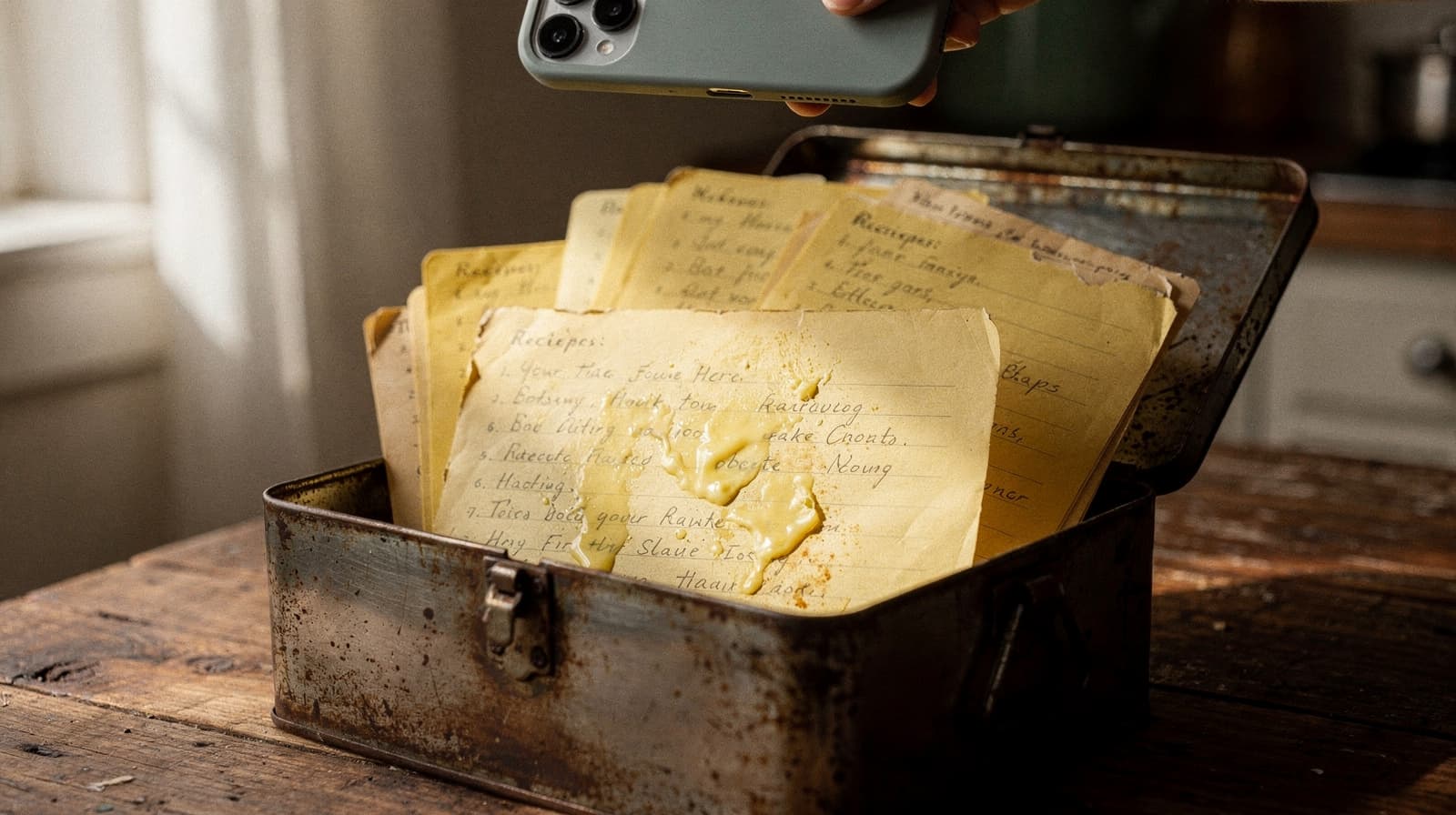
The instinct is to type the recipe up and call the job done. Don't skip the photo. An image of the card keeps what a transcription throws away, which is the handwriting itself, the butter stain that tells you which recipe she made most, and the margin note somebody else added a generation later.
Photograph it flat, in daylight near a window, with the flash off. Flash blows out pencil on a cream card and puts a hotspot where the ink is faintest. Phone scanner apps that flatten and de-skew work well here; aim for something you can zoom into and still read, which in practice means filling the frame with the card rather than shooting the whole table.
One photo per card. A stack photo looks efficient for about ten minutes and is useless afterwards, because you can't read past the top card and you can't crop or search it per recipe.
Transcribing shorthand without losing the voice
Old cards run on shorthand that made sense to one person. "Butter, size of an egg." "Bake till done." "A pinch." Resist the urge to correct all of that into modern precision. Write both. Keep the original phrasing exactly as it appears, then add a bracketed equivalent once you've cooked it and know what the phrase meant. "Butter, size of an egg [about 2 tablespoons]" keeps the voice and still works for someone who never met the writer.
If a measurement is illegible, say so instead of guessing quietly. "Oven temp unclear, tested at 350°F, 40 minutes, worked" is honest and useful. A silent guess presented as fact rewrites the recipe for everyone who inherits your transcription, and there's no way for them to know it happened. How to write your own recipes covers the general version of turning vague instructions into ones someone else can follow.
Ask before the people who can read it are gone
Some cards are only readable, in the sense of understandable, by the person who wrote them or someone who cooked beside them for years. "1 c. tomatoes" might be one cup or one can, and only a family member knows which. That's 8 ounces or 28, and the sauce is a different dish either way.
If that person is still around, go and cook the recipe with them and record the conversation on your phone. That's twenty minutes, and it's the part of the archive that disappears first. The card outlives the ability to read it by decades.
Splitting the archive across a family
A recipe box in one house is a single point of failure and a single point of access. Once the cards are photographed and transcribed, the job is getting the collection into the hands of the siblings, cousins and adult kids who didn't inherit the box.
A shared digital collection covers both. Everyone holds a copy, and everyone can add notes without overwriting anyone else's. RecipeClip's recipe sharing and collections let a family share access to a set of recipes, so a cousin who never had the physical box can still cook from it, and additions (a recipe someone else in the family also has, in a slightly different version) can sit alongside the original instead of replacing it.
Different family members' handwriting or slightly different versions of the "same" recipe are worth keeping distinct rather than merged into one. Grandma's version and her sister's version of the same dish, if they diverge, are both worth preserving with attribution, not quietly resolved into a single "correct" one.
What to do with the physical cards after
Digitizing doesn't mean discarding. The card carries the handwriting, the stains and the history, and no photo replaces the object. Store the originals somewhere dark, dry and stable, ideally in an acid-free sleeve rather than the rubber band they arrived in, since rubber perishes and welds itself to paper within a few years. A kitchen drawer is the worst place available; heat and steam are what fade pencil in the first place.
Print copies for the family members who'd want one instead of consolidating everything back into a single box in a single house.
Don't try to do the box in a weekend. Photograph and transcribe two cards a month, starting with the ones written by people who are no longer here to explain them.