The Dense Bean Salad Formula, and Why It Keeps All Week
A ratio-based bean salad that holds up in the fridge for days, built from pantry cans and whatever chopped vegetables you have on hand.
Three cans of beans, a cup of chopped vegetables, a sharp vinaigrette, and a handful of something salty. That's a dense bean salad, and unlike a lettuce-based salad, it gets better after a day in the fridge instead of wilting into something sad by Wednesday.
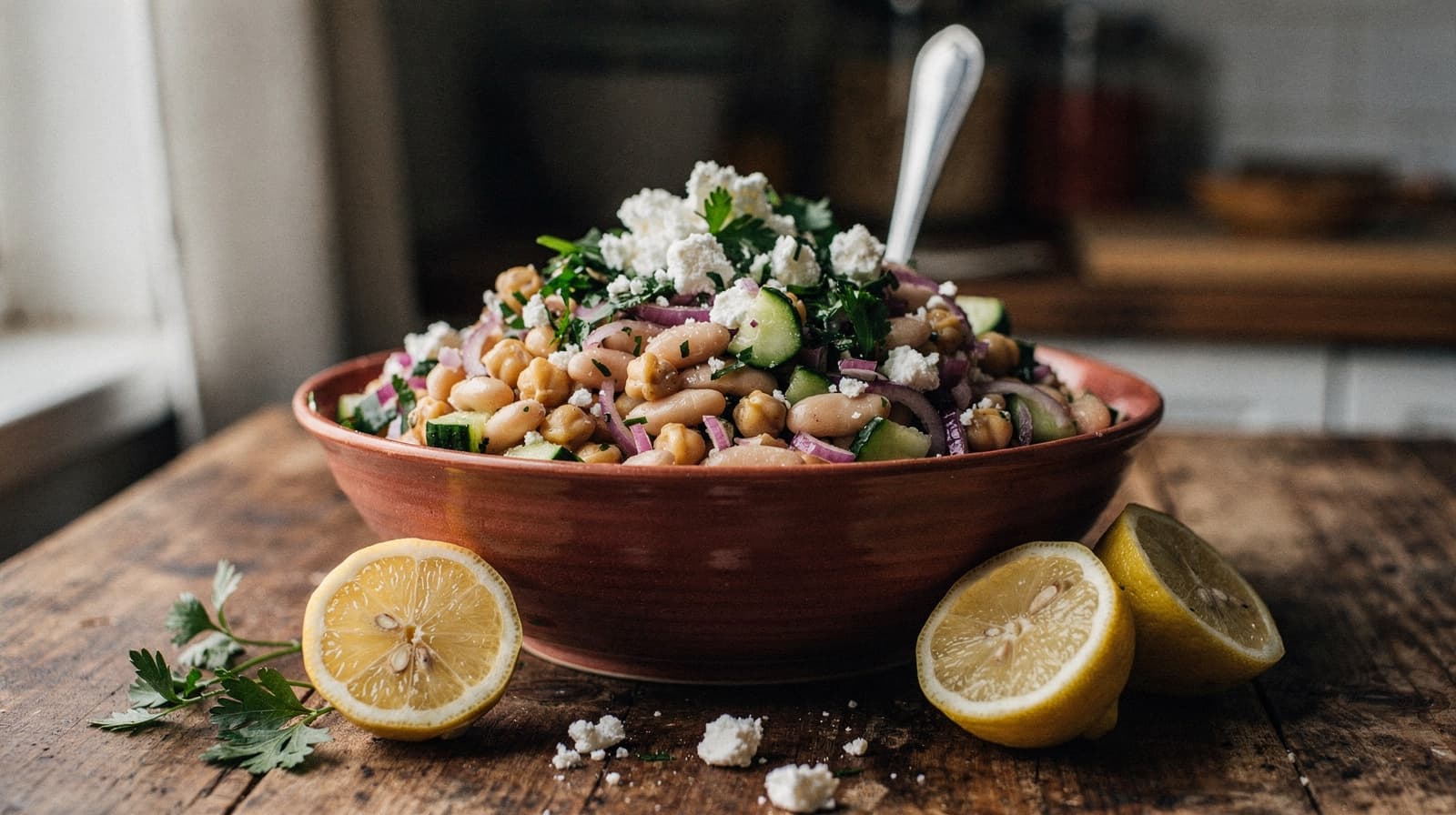
The name describes the texture, not the calorie count. "Dense" means packed with beans and chopped vegetables rather than built on a base of leafy greens that go limp under dressing. No lettuce means no clock ticking on when you have to eat it.
Why it survives the fridge
Leafy greens wilt because their cell walls are thin and the acid in a dressing breaks them down within hours. Beans, cucumber, bell pepper, and red onion have sturdier cell structure, and they improve as they sit, because the vinaigrette soaks in instead of coating the surface. A bean salad made Sunday is better on Wednesday than it was on day one.
That makes it one of the few meal-prep dishes that doesn't need to be reheated or reassembled daily. Portion it into containers once and it's ready as a side, a lunch, or a base for a bigger bowl for the next 4-5 days.
The base ratio
For roughly 6 servings: 3 (15-ounce) cans of beans, drained and rinsed; 2 cups of chopped raw or roasted vegetables; 1/3 cup vinaigrette; 1/2 cup of a salty or briny addition; fresh herbs to taste.
Mix at least two bean varieties for textural range. Chickpeas hold their shape and add bite; black beans are softer and creamier; cannellini beans split the difference. Three cans of the same bean works fine too, but the salad reads as more interesting with variety.
What goes in
- Beans: chickpeas, black beans, cannellini, kidney, or a three-bean mix from a single can if you want to skip the sorting
- Vegetables: diced cucumber, bell pepper, red onion (soak it in cold water for 10 minutes first to mellow the bite), halved cherry tomatoes, shredded carrot, or roasted zucchini and squash for a warmer version
- Salty or briny: feta or cotija, chopped kalamata olives, capers, or crumbled bacon if you're not keeping it vegetarian
- Herbs: parsley, cilantro, dill, or basil, chopped just before serving so they don't blacken over the week
The vinaigrette that holds up
A standard 3:1 oil-to-acid vinaigrette (3 tablespoons olive oil to 1 tablespoon vinegar or citrus juice) is too mild for a salad this dense; the beans need more acid to cut through, so drop the ratio closer to 2:1. Whisk together 1/4 cup olive oil, 2-3 tablespoons red wine vinegar or lemon juice, 1 teaspoon Dijon mustard, 1 minced garlic clove, and salt and pepper to taste. Toss the beans in this while they're still slightly warm from rinsing under hot water if you want maximum absorption; warm beans take on dressing better than cold ones straight from the fridge.
Five combinations that work
- Chickpea, cucumber, red onion, feta, dill, lemon vinaigrette (Greek-leaning)
- Black bean, corn, bell pepper, cotija, cilantro, lime vinaigrette (Southwest-leaning)
- Cannellini, roasted zucchini, cherry tomato, parmesan, basil, red wine vinaigrette (Italian-leaning)
- Kidney bean, celery, red onion, hard-boiled egg, parsley, mustard vinaigrette (closer to a classic bean salad)
- Three-bean mix, shredded carrot, olives, capers, oregano, red wine vinaigrette (pantry-only version)
Any of these scales up for a potluck or down for solo lunches without changing the underlying ratio.
Storage details that matter
Refrigerated in a sealed container, a dense bean salad holds for 5-6 days, longer than most cooked dishes, because the acid in the vinaigrette works as a mild preservative and there's no dairy or mayonnaise in the dressing to spoil. Feta or a hard-boiled egg is the exception. Both keep the same 5-6 days, but smell them on day 4 instead of trusting the number.
Making a double batch to stretch across two weeks? Hold back the herbs and the cheese and add them to each portion as you serve it. Parsley blackens and goes flat within two days even in an acidic dressing, so the day-five portion from an all-at-once batch tastes like a tired version of the day-one one.
Using it beyond a side dish
A dense bean salad works as a side on its own, but it also functions as a component for bigger meals across the week, similar to how batch-cooked proteins get reused. Spoon it over greens for a heartier lunch salad. Stuff it into a pita with hummus. Warm a portion in a pan with a fried egg on top for breakfast. Add it to a grain bowl alongside rice or farro.
The nutrition is a free side benefit. Three cans of beans across six servings puts roughly 10-12 grams of protein and 8-10 grams of fiber in each portion, before you count the cheese or egg.
Scaling it for a crowd versus scaling it down
The ratio holds whether you're feeding two people or twenty, which makes it a safe potluck choice. Doubling or tripling works cleanly because nothing in the formula depends on pan size or oven timing the way a baked dish would. One adjustment at volume: taste the dressed salad before it leaves the house, since a triple batch usually wants another tablespoon of vinegar to taste as bright as a small one.
Scaling down for one or two people works just as easily. A single can of beans, a cup of chopped vegetables, and a scaled-down two tablespoons of vinaigrette makes enough for 2 servings, and it stores through the same 5-6 day window since the ratio, not the total quantity, is what determines how well it holds.
Making it a repeat
Because the formula is flexible, it's easy to make once and then forget the exact combination that worked. Write down the version you liked, ideally with the vinaigrette ratio, so you're not reinventing it from scratch next time. Saving it in RecipeClip alongside your other go-to sides means it shows up in your rotation instead of disappearing after one good batch.
Rinse the beans, chop what's in the crisper drawer, and whisk the dressing while the beans drain. Fifteen minutes, and lunch is handled through Thursday.