Breakfasts You Make Once and Eat All Week
Weekday breakfasts that hold up for five days without turning to mush. What to make, how to store it, and how long it actually lasts.
Most weekday breakfasts get decided at 7:15 AM by whatever's fastest, which means cereal, a granola bar, or nothing. That's not a discipline problem. It's a prep problem, and an easy one, because breakfast repeats the same format every day in a way dinner never does.
Make one format on a weekend morning, eat it four or five days running, and vary the toppings enough that it isn't the identical bowl on Thursday. Here's what holds up and what doesn't.
Baked oatmeal holds better than you'd expect
Baked oatmeal (oats, eggs or a flax egg, milk, a mashed banana, cinnamon, and mix-ins like berries or chopped nuts, baked in a 9x13 pan at 375°F for about 35 minutes) cuts into squares that reheat in 60-90 seconds in the microwave. A 9x13 pan holds about 3.5 quarts of batter, enough for 8-9 squares, which covers a work week with one to spare.
It keeps 5 days in the fridge without going soggy. Stovetop oatmeal made ahead is gummy by day three; this isn't. Past five days, freeze the squares individually and reheat straight from frozen with an extra 30 seconds in the microwave.
Egg muffins are the most flexible option
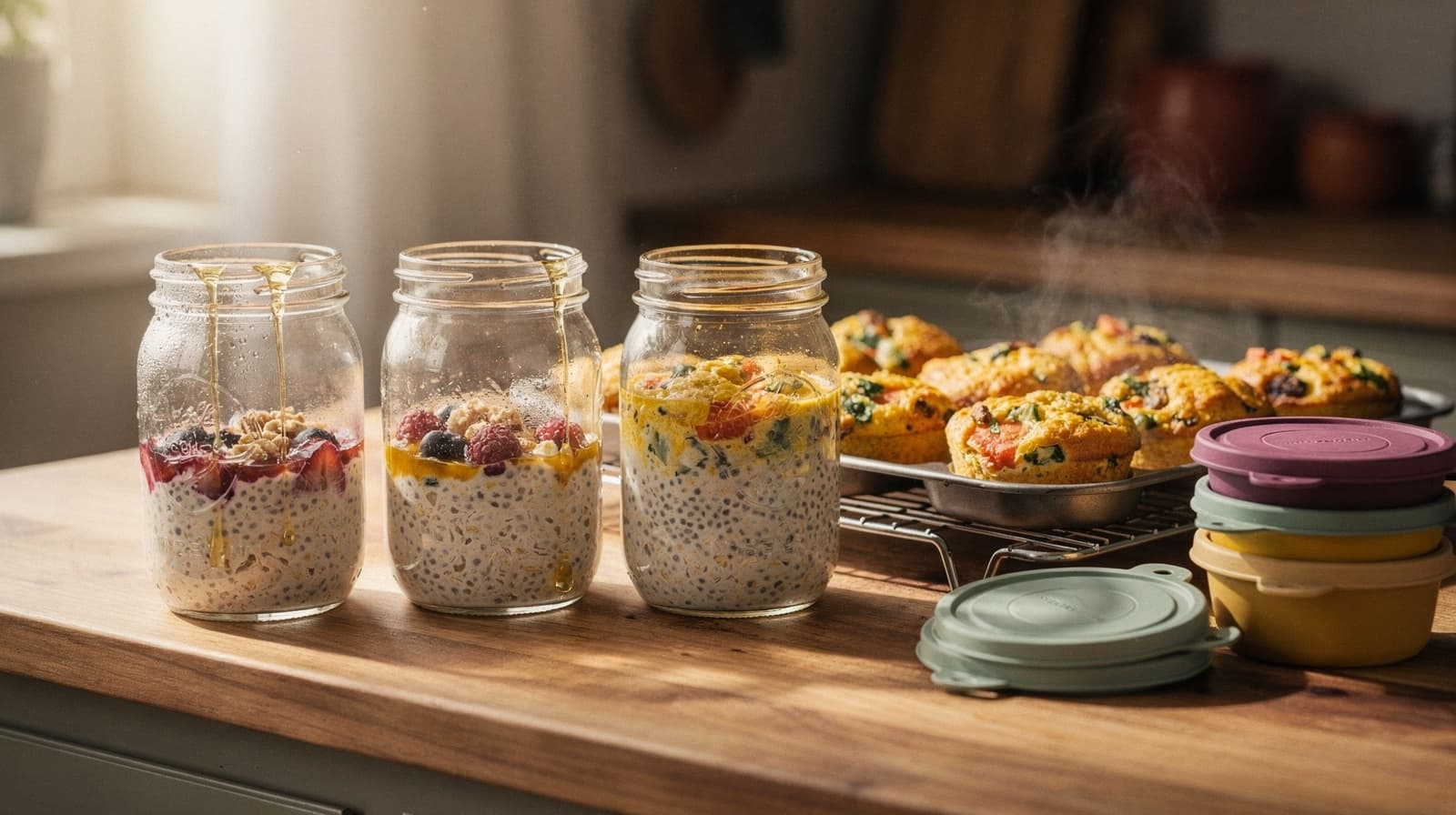
Whisked eggs poured into a muffin tin with chopped vegetables, a little cheese, and diced cooked ham or sausage, baked at 350°F for 18-20 minutes, make a protein-forward breakfast that reheats in under a minute. A standard 12-cup muffin tin makes exactly a week's worth if you're eating two a day, or two weeks at one a day.
They keep 4-5 days refrigerated and freeze for up to two months beyond that. There's one way to ruin them, and it's overfilling the cups. Eggs puff in the oven and will climb over the rim and weld themselves to the top of the pan, so stop at two-thirds full.
Overnight oats need almost no cooking at all
For mornings where even reheating feels like too much, overnight oats (rolled oats, milk or a milk alternative, a spoonful of yogurt, chia seeds, and a sweetener, combined in a jar and refrigerated overnight) are ready cold, straight out of the fridge. No stove, no microwave.
Make 4-5 jars on Sunday with the same base and different mix-ins: berries in one, peanut butter and banana in the next, cocoa powder in the third. They hold 4-5 days before the oats go slack, which covers a work week with nothing to spare.
Breakfast burritos for the freezer specifically
Unlike the other three formats, breakfast burritos are built to be frozen from the start rather than just refrigerated. Scramble eggs with cooked sausage or black beans, cheese, and a little sautéed pepper and onion, roll tightly in a large tortilla, and wrap each one individually in foil or plastic before freezing.
They keep up to 2 months frozen. Reheat one in about 2 minutes in the microwave, unwrapped and sitting on a paper towel so the tortilla doesn't steam itself soggy, or give it 20 minutes at 375°F from frozen if you want the outside crisp.
Because each one is wrapped on its own, this is the breakfast you can hand to someone already halfway out the door. No plate, no fork.
What doesn't survive a week
Four formats fail at batch prep. Learn them before you spend a Sunday morning finding out.
- Scrambled eggs made ahead go rubbery and weep water on reheat. Bake the eggs into a muffin or a frittata instead
- Toast, or anything meant to be crisp, softens in a container within hours. Make the bread component fresh daily even when everything else is prepped
- Smoothie packs freeze well, blended smoothies don't. Bag the fruit and greens and blend each morning
- Pancakes and waffles freeze fine and refrigerate badly. Freeze them individually and toast from frozen
Building this into the rest of your week
Fold breakfast into the prep session you're already doing, rather than adding an errand. If a tray of something for dinner is already in the oven at 375°F, a pan of egg muffins goes in beside it and costs you the five minutes it takes to whisk eggs.
Our weekly meal prep guide covers structuring one prep session around multiple meals instead of treating breakfast, lunch, and dinner as three projects. And if the freezer becomes part of the rotation, freezer meal planning has the keeping times and the labelling habit that stops things turning into unidentifiable blocks six weeks later.
The time cost
Baked oatmeal and egg muffins each run about 15 minutes of hands-on work plus 20-35 minutes of baking you can walk away from. Overnight oats take 5 minutes a jar and no cooking. None of this needs a Sunday ritual; a 45-minute window buys a full week of breakfasts.
Pick one format, make it this weekend, and taste it on day four before you commit to a rotation. Egg muffins if you want savory and portable, baked oatmeal if you want something sweet. Either one beats cereal eaten standing at the counter.