Planning Meals Around the Sale Flyer Instead of the Other Way Round
How to build a week of dinners from what's actually discounted this week, and save 20-30% on groceries without clipping coupons.
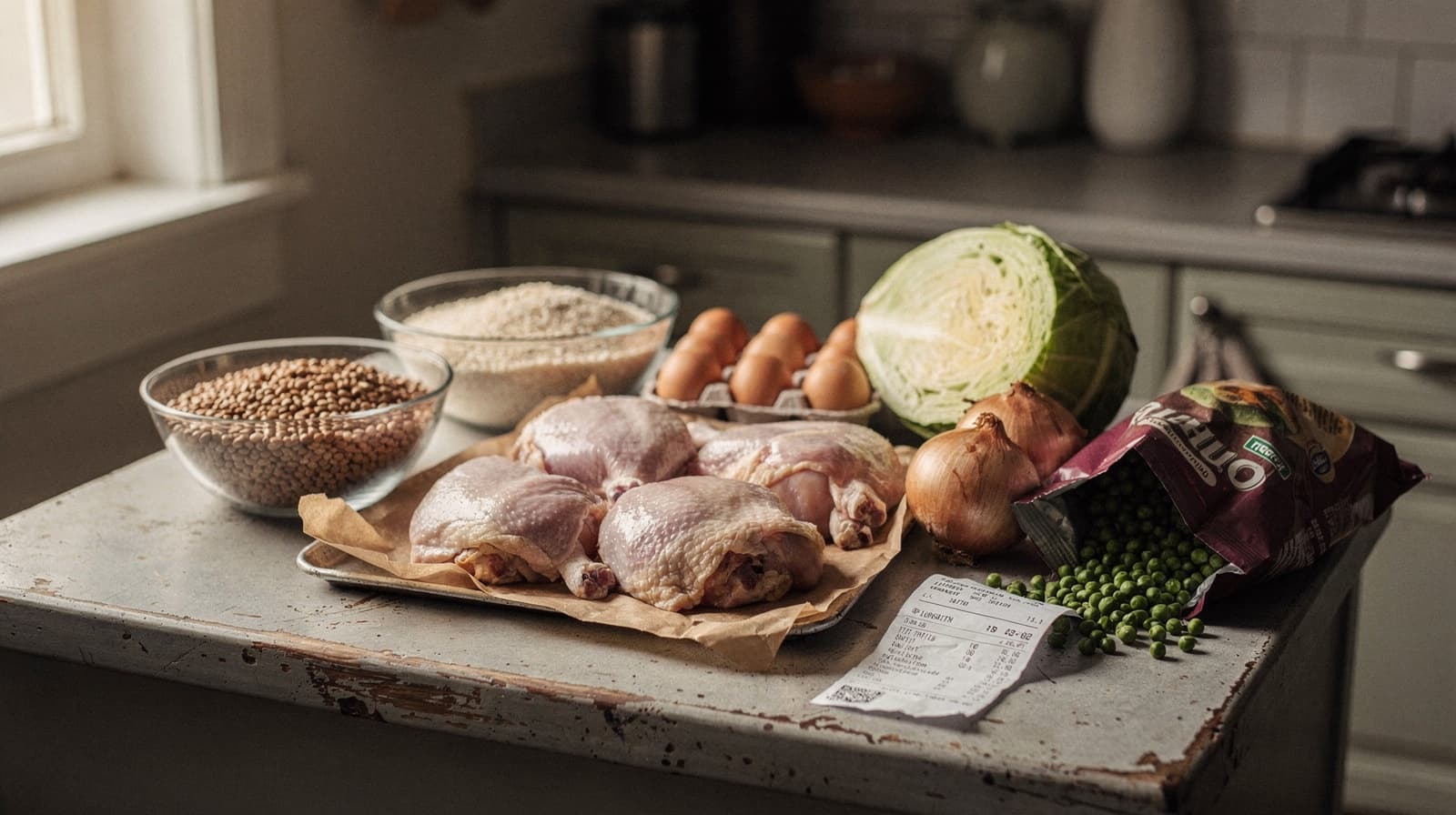
Most meal planning starts with a recipe and ends at the grocery store, paying whatever that recipe's ingredients cost that week. Flip the order. Start at the sale flyer, and the recipe follows from what's cheap right now. It's the difference between paying full price for chicken breast because a recipe demanded it and building dinner around the pork shoulder that's $1.50/lb off this week because the store needs to move it.

Grocery stores rotate loss leaders weekly, items priced below or near cost to get you in the door. Meat and seasonal produce see the steepest swings, sometimes 30-40% off a normal price. Planning around those swings instead of a fixed recipe list does more for a grocery budget than almost anything else you can control, and it takes maybe 10 extra minutes a week.
Reading a flyer for real signal
Most flyers bury four or five real loss leaders inside a page of noise: items marked "sale" at eight cents off, or bundle deals that only pay if you buy more than you need. The real ones sit on the front page in the biggest print. Anything under 20% off isn't worth restructuring a week around.
Proteins are where the biggest swings happen. Chicken thighs might run $1.99/lb on sale versus $3.49/lb normally. Ground beef swings between $4.99 and $6.99/lb depending on the week. Pork shoulder, often the cheapest cut in any given week, can drop to $1.49/lb during a sale versus $2.99 normally. Building a week around whichever protein is at its low point, rather than whichever one a specific recipe called for, is where most of the savings live.
Building the week backward
Once you know what's cheap, work backward instead of forward:
- Pick the discounted protein first, before choosing any dish
- Decide two or three cooking methods that work for it (roasted, braised, ground into something) rather than committing to one specific recipe immediately
- Check what vegetables are also discounted or in season, since produce sales often cluster around the same items the store is trying to move
- Fill in the rest of the week's meals from pantry staples and whatever's left in the fridge, saving the sale-priced ingredients for the nights that need the most help stretching a budget
- Buy slightly more of the discounted protein than one week needs if it freezes well, since the sale won't be there again next week
This is close to the same logic as cooking once and eating three different meals: a large batch of one discounted protein becomes the backbone for multiple nights, finished differently each time so it doesn't feel repetitive.
What to stock up on versus what to buy fresh weekly
Buy shelf-stable items in volume when the price drops. Canned tomatoes, dried pasta, rice, and canned beans have no clock on them, so six cans at $0.89 beats two cans at $1.40 every time.
Fresh produce and meat are the opposite. Extra peppers bought on sale become slime in the crisper drawer by Saturday unless you have a plan, and probably a freezer plan, for the surplus. A produce sale only counts if you eat what you bought. Otherwise it's food waste wearing a discount sticker.
Tracking prices well enough to spot a real deal
You can't spot a real sale without knowing what things normally cost. In most regions, boneless chicken breast runs $3.50-4.50/lb, ground beef $5-7/lb, and pork shoulder $2.50-3.50/lb. Anything well under those numbers is worth building a week around. Anything a few cents off isn't.
Stores also cycle the same items on a rough schedule, often monthly. Watch for two months and you'll know when your household's most-used protein hits its low point. Chicken thighs on sale every four weeks means stocking the freezer on those weeks instead of paying $3.49/lb on the three weeks in between.
Where this saves the most
The households that benefit most from sale-driven planning are the ones already cooking regularly, since the savings compound across every week rather than showing up once. A family going through 3-4 lbs of protein a week saves roughly $6-10 weekly just from buying the discounted cut instead of whatever a recipe specified, which adds up to $300-500 a year without changing how much anyone eats or cooks.
The tradeoff is rigidity. You give up knowing on Sunday exactly what Thursday is. If your household needs the certainty of a fixed plan two weeks out, sale-chasing will feel disruptive. If your plan already has some flex built in, like the approach in meal planning on a budget, sale-driven substitution slots in without much friction.
Where sale-chasing stops being worth it
Cap it at two stores. Three stores in one week to catch each one's best deal costs more in gas and driving time than the spread is worth, and a five-cent-per-pound difference across town never pencils out once you count the trip. Compare two flyers, take the better protein deal, stop there.
Loyalty apps and digital coupons add another few percent on top of the flyer sales. Treat them as a bonus on a plan already built around the loss leaders. Clipping twenty coupons for things you weren't going to buy raises the total bill, even when every single coupon is a real discount.
Making the swap easy week to week
The habit that makes this sustainable is having a rotation of recipes flexible enough to accept whatever protein is cheapest, rather than recipes that demand one specific cut. A braise, a stir-fry, a sheet pan dinner, and a soup base all tolerate a protein swap without the dish falling apart.
Tag your saved recipes by protein type in RecipeClip so when chicken thighs are the deal of the week, you can pull up every recipe that works with them instead of starting from a blank page.
This Sunday, open your store's flyer before you open any recipe. Find the one protein that's more than 20% off and start there.