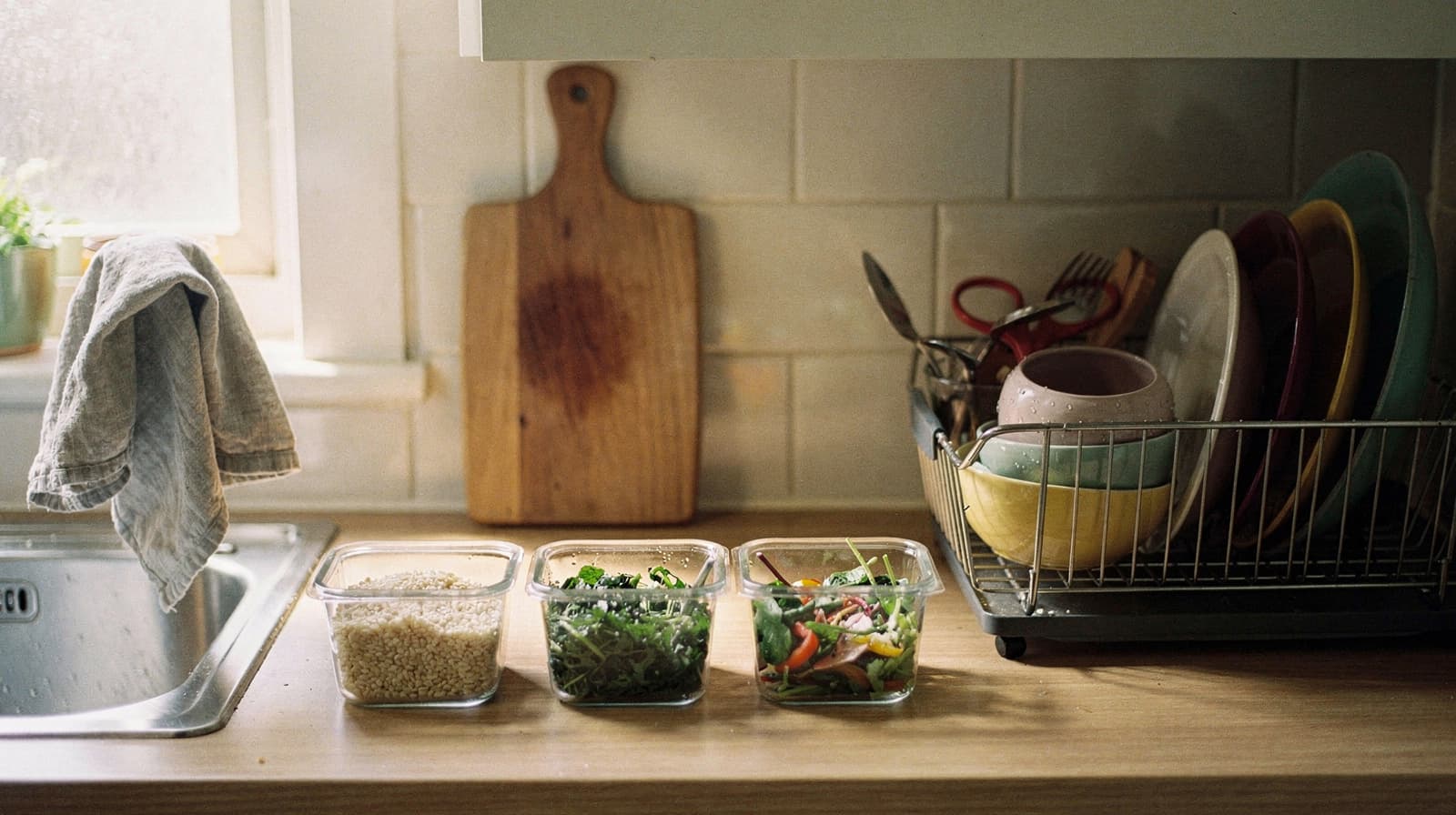
How to Organize a Small Kitchen (Without Losing Your Mind)
Practical tips for organizing a small kitchen: vertical storage, smart zones, and ruthless decluttering so you can cook without moving three things first.
A small kitchen doesn't mean a bad kitchen. Some of the best meals in the world come out of tiny galley kitchens, cramped apartment corners, and spaces that barely fit two people standing side by side. The problem isn't the size. It's how the space is organized.
Most small-kitchen advice tells you to "get creative with storage." That's vague and unhelpful. What you need is a system: a way to decide what stays, what goes, where everything lives, and how to make cooking feel smooth instead of like a wrestling match with your own countertop.
Here's how to do it.
Start by decluttering (ruthlessly)
Before you buy a single organizer, shelf, or hook, you need to get rid of things. This is the step everyone skips and the reason most kitchen organization fails within a month.
Pull everything out: every drawer, every cabinet. Put it all on your table or floor. Then sort into three groups:
- Use weekly: These stay in prime real estate (eye-level shelves, front of drawers)
- Use monthly: These go in harder-to-reach spots (high shelves, back of cabinets)
- Haven't used in 6+ months: These leave your kitchen entirely
Be honest. That waffle maker you used once in 2023? The duplicate set of measuring cups? The bread machine collecting dust? They're taking space from things you actually use every day.
The "would I buy this again?" test
For anything you're unsure about, ask: If I didn't own this, would I spend money to buy it right now? If the answer is no, donate it. A small kitchen has no room for "maybe" items.
Use vertical space like your life depends on it
In a small kitchen, your walls are your best friend. Counter space is precious, and every square inch of it matters. Go vertical instead.
Magnetic knife strips replace bulky knife blocks and free up 6–8 inches of counter space. Mount one on the wall near your prep area.
Hooks under cabinets hold mugs, measuring cups, and small tools. You'd be surprised how much you can hang from the underside of upper cabinets without it looking cluttered.
Pegboard walls are having a moment, and for good reason. A 2x3-foot pegboard can hold pots, pans, utensils, and small shelves, all visible, all accessible, all off your counters.
Shelf risers inside cabinets effectively double your shelf space. Stack plates on the bottom, put a riser over them, and use the space on top for bowls or cups. Simple, cheap, transformative.
Organize by cooking zones
Professional kitchens are organized into stations. Your small kitchen should be too, just scaled down. Think in zones:
Prep zone: Cutting board, knives, mixing bowls, measuring tools. Keep these within arm's reach of your main counter space. If you're working with a weekly meal prep routine, having your prep zone dialed in saves massive time.
Cooking zone: Pots, pans, oils, spices, spatulas. These live near the stove. If your spice collection has grown beyond what fits near the range, check out our guide on pantry organization for a system that works.
Cleaning zone: Dish soap, sponges, drying rack. Near the sink, obviously. Keep this area minimal so it doesn't eat into your prep space.
Storage zone: Food storage containers, dry goods, backup supplies. This is the zone most people let sprawl. Contain it.
The container problem (and how to fix it)
Let's talk about food storage containers, because they're the single biggest source of cabinet chaos in most kitchens.
Here's the fix: pick one system and commit to it. Get rid of every mismatched container, every lid without a bottom, every takeout container you've been "reusing." Replace them with a single set of stackable, same-brand containers in 3–4 sizes.
Store lids separately in a small basket or use a lid organizer mounted inside a cabinet door. This alone can reclaim an entire shelf.
Small kitchen, smart appliances
In a small kitchen, every appliance needs to earn its counter space. The rule is simple: if it doesn't get used at least once a week, it lives in a cabinet or it leaves.
Appliances that earn their spot in most small kitchens:
- Instant Pot or multi-cooker: replaces slow cooker, rice cooker, and pressure cooker
- Good toaster oven: can replace a full-size oven for small batches
- Immersion blender: takes up almost zero space versus a full blender
Appliances that usually don't earn their spot: stand mixers (unless you bake weekly), air fryers (if you have a toaster oven with convection), and single-use gadgets like egg cookers or avocado slicers.
The inside of cabinet doors is free real estate
This is one of the most underused spaces in any kitchen. The inside of your cabinet doors can hold:
- Measuring spoon and cup hooks
- Small racks for spice jars
- Corkboard or whiteboard for grocery lists
- Lid organizers
- Bag clips and twist ties
Command hooks and adhesive-mounted organizers work perfectly here and don't require drilling.
Keep your counter workflow clear
Here's a rule that will change your daily cooking experience: keep your main prep area completely clear when you're not cooking. Nothing lives there permanently.
This means finding homes for the things that tend to drift onto counters: mail, keys, small appliances, fruit bowls that are really just clutter magnets. Dedicate a single small tray for the 2–3 items that genuinely need to be on the counter (like a soap dispenser and a paper towel holder), and keep everything else stored.
When you start cooking, you want a clean surface to work on. That's the whole point. If you're already cooking in a small space, batch cooking proteins is a great strategy — cook once, eat all week, and minimize how often you need to deal with the kitchen chaos.
Go digital with your recipes
One thing that silently eats counter space in small kitchens: cookbooks, printed recipes, and recipe cards scattered in drawers. Moving your recipe collection to a digital app frees up physical space and makes recipes accessible from your phone while you cook — no propping open a book on the counter.
RecipeClip lets you save recipes from anywhere on the web, organize them into collections, and pull them up on your phone while you cook. It's one less physical thing competing for space in your kitchen.
The maintenance habit
Organizing a small kitchen is a one-time project. Keeping it organized is a habit. The good news: it only takes about 5 minutes a day.
After cooking: Put everything back in its zone. Not "on the counter near where it goes" — actually back in its spot.
Once a week: Quick scan of your fridge and pantry. Toss anything expired. Note what needs restocking.
Once a month: Open every cabinet. Is anything accumulating that shouldn't be? Has anything migrated from its zone? Reset.
The smaller the kitchen, the faster things get messy — but also the faster they get clean. Five minutes of intentional tidying keeps a small kitchen functioning like one twice its size.
A small kitchen is a constraint, not a limitation
A small kitchen forces you to be intentional about what you keep, where you put it, and how you cook. The best small kitchens aren't organized because they have more storage solutions. They're organized because they have fewer unnecessary things.
Your kitchen is small. Your cooking doesn't have to be.
Start with the waffle maker. And when you're ready to get the cookbooks off the counter too, RecipeClip will hold the recipes.