Easy Crème Caramel Recipe
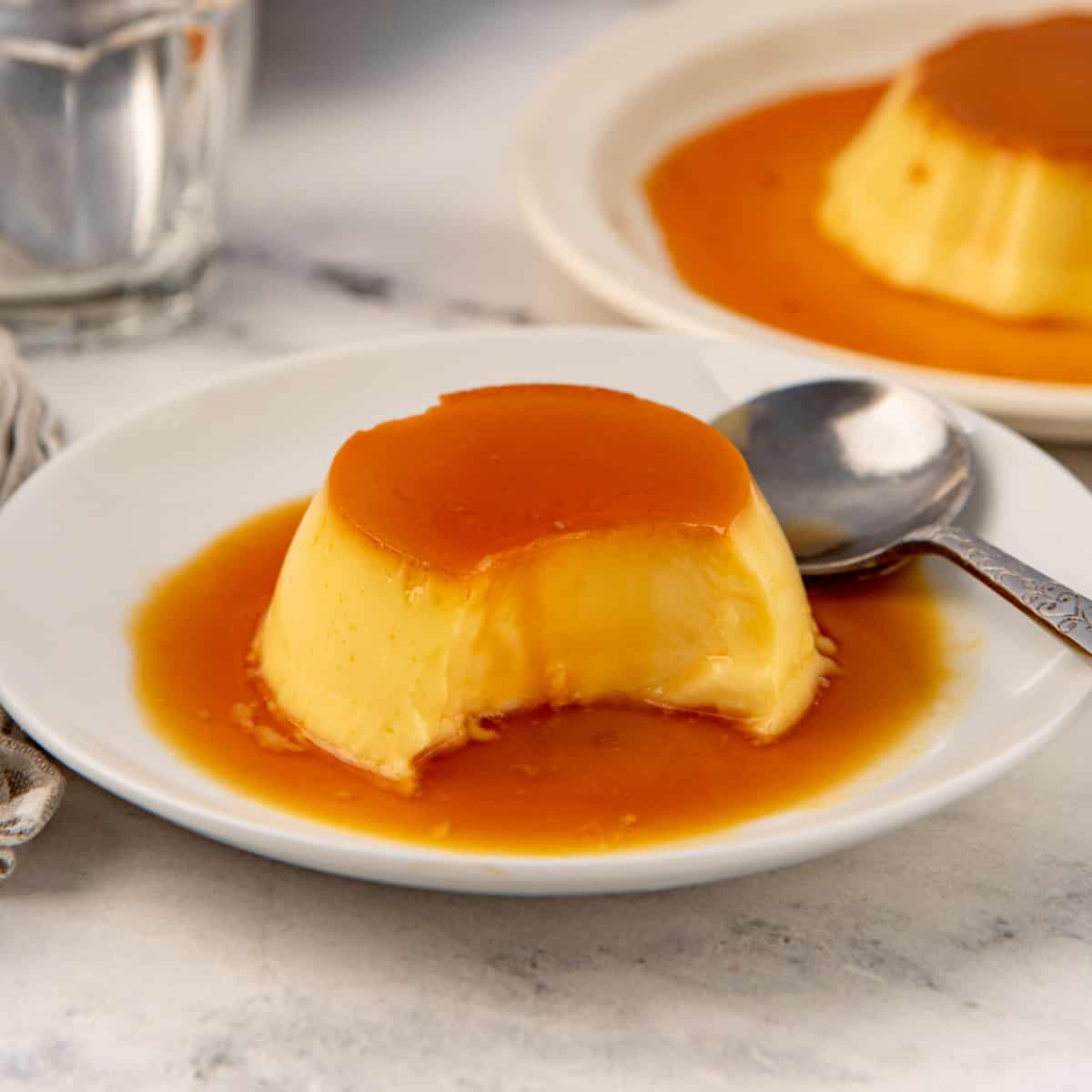
Ingredients
- 120 g white sugar (⅔ cup)
- 3 tbsp water (optional)
- 2 tbsp corn syrup (optional)
- 500 mL whole fat milk
- 2 pieces of lemon peel or orange peel
- 2 whole eggs
- 3 egg yolks (see recipe notes below for how to use only whole eggs)
- 2 tsp vanilla extract (or vanilla bean paste (see recipe notes))
- 100 g white sugar (½ cup)
- ¼ tsp sea salt
Steps
- 1
For individual portions, wash and dry the baking dishes. If you’re using a larger dish to make one big pudding, wash and dry the dish as well. See recipe notes for the number of the portions you can make with this recipe. Here, I’m using 6 or 7, 4 oz baking cups.
- 2
Preheat the oven to 350°F / 180°C.
- 3
Prepare a large baking tray that you can use as a water bath. The ramekins / baking cups should be able to sit in the water bath with at least 1 inch space between them (they should not be touching). Place a kitchen towel at the bottom of the water bath tray. Set aside until you need it.
- 4
For this recipe, I make a dry caramel, as I find it easier to caramelize that way because the risk of recrystallization is lower. But you can also make a wet caramel as well.
- 5
See recipe notes for wet caramel instructions. Water and corn syrup will be added to the sugar. The corn syrup helps to prevent crystallization.
- 6
Place the sugar in a stainless steel skillet. The sugar should form a fairly thin layer on the base of the skillet for quick and even melting. Make sure the skillet is clean and dry before you add the sugar.
- 7
Place the skillet over medium heat. Make sure not to leave the sugar unattended while you make the caramel.
- 8
The sugar that is in contact with the bottom of the skillet will start to melt first. Use a silicone spatula to push the melted sugar aside, and gently shake the pan to evenly melt the rest of the sugar.
- 9
As the sugar melts and is stirred, the caramel will turn a light yellow color and will form lumps of undissolved sugar.
- 10
Remove the pan from the heat and stir the mixture and break up the lumps, until most of the sugar is dissolved.
- 11
Return the caramel to the stove and cook the caramel while frequently stirring. The caramel will turn dark yellow and then a golden color. Finally, it will turn an amber color.
- 12
As soon as the caramel turns amber in color, remove the pan from the heat and switch off the stove.
- 13
VERY CAREFULLY pour the caramel into the ramekins (metal or porcelain). Only add enough caramel to coat the bottom of the baking dishes / cups. At most, 5 mm thick (just eyeball it). Make sure the caramel layer is smooth and doesn’t have any thick streaks.
- 14
Set aside until the custard base is ready.
- 15
The first step of making the custard is to infuse the milk (if needed). If using fresh vanilla beans, or adding the lemon peel, this step is necessary.
- 16
Place the milk (and cream, if using) in a saucepan.
- 17
Cut the vanilla bean in half and scrape off the caviar. Place the caviar and the vanilla bean in the milk mixture. Also add the lemon peel in the milk, if using.
- 18
Heat the milk over medium heat, while stirring occasionally. Heat until the milk is steaming, or is at a light simmer.
- 19
As soon as the milk is heated, remove it from the stove and let the milk infuse for at least 30 minutes.
- 20
When the milk temperature comes down to about 160°F / 71°C or lower, it's ready to be used.
- 21
This step can be done first, and the caramel can be made while the milk is infusing as well.
- 22
If the milk does not need to be infused, heat the milk until it’s just starting to steam over medium heat. This will be about 150°F / 65°C.
- 23
Remove the milk from the heat and set aside.
- 24
In a large jug or bowl, place the eggs and egg yolks, vanilla extract (if you’re not using vanilla beans), salt, and sugar.
- 25
Whisk until the eggs are mixed very well and the mix is slightly frothy. There should be no egg lumps in the mixture.
- 26
Temper the eggs with the warm milk mixture (infused or not infused). This is done by streaming the hot milk very slowly into the egg mixture while constantly whisking the egg mixture. If the warm milk is added too fast or not mixed well, it could scramble the eggs - so add the milk slowly, a little at a time.
- 27
Once the egg mixture has warmed up to almost the same temperature as the milk, the eggs have been tempered.
- 28
Add the tempered egg mix into the remaining milk in the saucepan, and whisk to combine. Now you have the custard base.
- 29
Strain the custard base using a sieve, into a jug. This will remove any lumps, and vanilla beans and lemon peel. The jug will make it easier to pour the custard into the baking dishes.
- 30
Carefully pour the warm custard into the baking ramekins with the caramel layer at the bottom.
- 31
Place the baking dishes in the water bath tray, on top of the kitchen towel. This will prevent any slipping. Have a piece of aluminum foil ready to cover the baking dishes as well.
- 32
Place the water bath baking tray with the creme caramel ramekin / ramekins inside the preheated oven. Carefully pour very hot water into the water bath tray, so that the water comes about halfway up the ramekins.
- 33
Cover with foil, and poke holes in the foil for the steam to escape.
- 34
Bake the creme caramels until the custard is set. This will take about 30 minutes for 4 oz portions, and up to 60 minutes for larger portions. Check the dishes after 20 minutes, and every 5 - 10 minutes afterwards.
- 35
The custard should set, but look wobbly in the middle. The best way to tell when the custard is done is to check the internal temperature of the custards. When the internal temperature registers at 175 - 176°F / 79 - 80°C, the custard is perfectly cooked.
- 36
Remove the baking tray from the oven and carefully remove the ramekins from the water bath and let them cool to room temperature.
- 37
Then transfer the ramekins to the fridge and let them chill overnight, or for at least 6 hours until they are completely chilled.
- 38
Release the edges of the custard in the ramekins by using a thin blade to run it along the edge of the custard. Or you can use clean fingers to gently push the custard to release it from the sides of the ramekin.
- 39
Then place the ramekins in very hot water (hot tap water is fine), for a few seconds to loosen the creme caramel. Alternatively, you can use a kitchen blow torch on the outside of the ramekins.
- 40
Finally, place the serving plate over the ramekin and flip them both over, while holding them together.
- 41
Firmly shake the ramekin a few times (NOT back and forth, just a sudden sharp shake downwards should do the trick), to help release the creme caramel from the ramekin. You will hear a plop sound when the custard is released.
- 42
Serve immediately as is. You can also serve it with a dollop of whipped cream.